Affinity
Maturation
Affinity Maturation : Chiome's Properietary Antibody Technology
It can improve the affinity of candidate clones acquired with the ADLib® system as well as antibodies acquired with other platforms (e.g. hybridomas). Further improvements to the proprietary technology have reduced the number of processes, resulting in a shortened timeline and reduced costs, compared to provious.
Advantages
◆ Mutagenesis of immunoglobulin genes using the intrinsic function of the cell.Mutation induction to immunoglobulin genes is completed within a few days using engineered cells expressing desired-existing antibodies.
◆ Candidates with higher affinity are efficiently selected within a single round of selection.
◆ Multiple antibodies per one antigen can be accepted concurrently.
Case 1. Affinity Maturation for Existing Antibodies (KI-AMP)
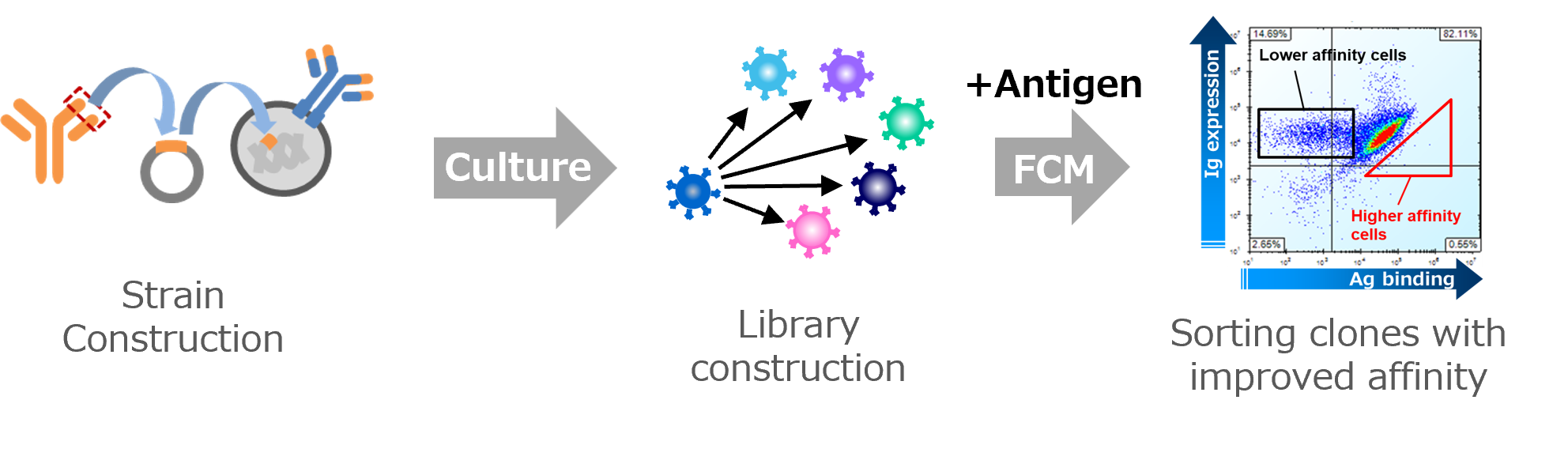
DT40 cell lines expressing the desired antibody are constructed based on the sequence information of antibodies already obtained on other platforms, such as hybridomas. Subsequently, mutations are introduced into the immunoglobulin genes of the DT40 cells, and candidate clones showing higher affinity are isolated.
- 1. Converting genetic information into desired-existing antibodies in a DT40 cell (strain construction).
- 2. The antibody expression and their antigen binding of construceted strains are verified.
- 3. Cells are cultured under specific conditions for a specified duration, and mutations are introduced into the immunoglobulin genes using proprietary technologies. A library containing various mutations in the antibody is produced.
- 4. Only cells with improved affinity are sorted using fluorophore-labelled antigens.
- 5. Candidate clones are further characterised by ELISA, sequence analysis, SPR analysis, etc.
Case 2. Affinity Maturation of ADLib® System-Derived Clones.
The process of affinity maturation for clones (DT40 cells) selected by the ADLib® system is very simple. Without any genetic manipulation, the library contains various mutation into the immunoglobulin genes of the original clone through controlled cell culture. After library preparation, higher-affinity candidate clones are isolated in the same way as in case 1. KI-AMP.
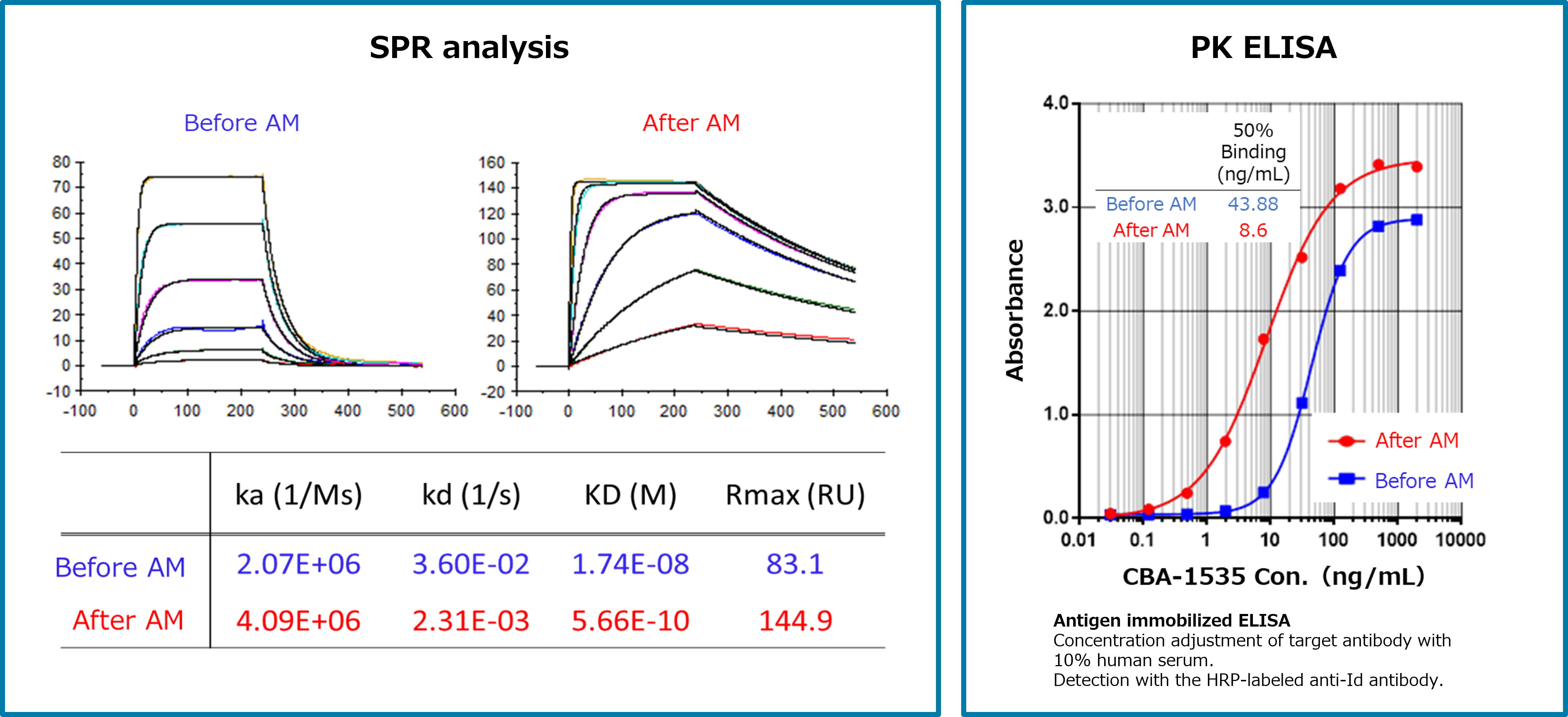
Case study: Affinity Maturation of Anti-Idiotypic Antibodies Selected by ADLib® Selection The anti-idiotypic antibodies intended for use in the CBA-1535 assay system (a humanized anti-5T4 and anti-CD3 bispecific antibody) under clinical development at Chiome were obtained from the ADLib® human library, and subsequently affinity maturation was performed.
This led to an improvement in KD values and a 5-fold increase in sensitivitly in the PK ELISA.
Click here on technical information on the ADLib® system