ADLib®
System
ADLib System®: A proprietary innovative antibody generating technology
Principle of ADLib® system
The DT40 cells derived from avian B cells have an ability of making a wide variety of antibody. We stimulate this avian mechanisms using Trichostatin A (TSA) to create diversified monoclonal antibody libraries in vitro during a short period of time. A specific antibody will be selected from a diversified libraries using specific binding between antigen and antibody. We designated this system as ADLib® system from Autonomously Diversifying Library.
In the ADLib® system, a desired antibody is obtained by selecting a cell expressing antigen-specific antibodies from the ADLib® library. Magnetic beads coated with a target antigen are used to collect the specific cells. Then, the antigen-bound cells are directly analyzed by flow cytometry (FCM) to strictly select cells that are more strongly bound to the antigen by sorting. FCM analysis can also monitor antibody expression levels on the cell surface so that decent expression of recombinant antibodies can be expected during the antibody-development process. In addition, DT40 cells not only present antibody molecules on the cell surface but also secrete them, facilitating some applications such as ELISA screening using the culture supernatant of each selected clone. In the ADLib® system, therefore, clones with higher specificity and stronger binding are selected in a short period of time (approximately 10 days of actual work) through the processes of selection by magnetic beads, FCM sorting, and ELISA screening as mentioned above.
Overview of ADLib® antibody generating system
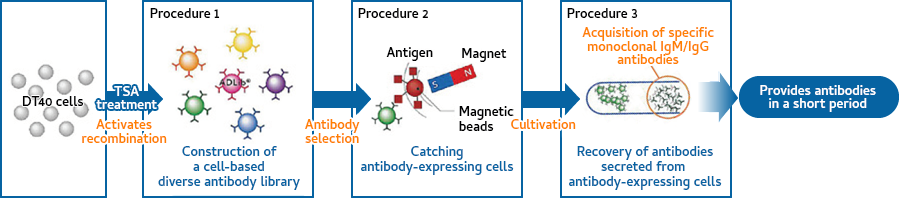
Affinity maturation is achieved in vitro using Chiome's unique technology. The antibody gene sequences of clones selected in the ADLib® system are rediversified by the unique mechanisms of the ADLib® system (secondary library), from which clones with higher affinity for the target are selected. Secondary libraries, which are generated using some biological mechanisms, are qualitatively different from common techniques (e.g., error-prone PCR, site-directed mutagenesis), and multiple secondary libraries can be generated at once in a short period of time (2 to 3 weeks) without the need for genetic engineering (Contract service can generate secondary libraries for up to 6 clones at the same time). *This technology can also be applied to antibodies derived from other platforms such as hybridoma technique to obtain high-affinity ones by generating genetically-engineered DT40 cells and secondary libraries with the same recipe.
Human ADLib® system
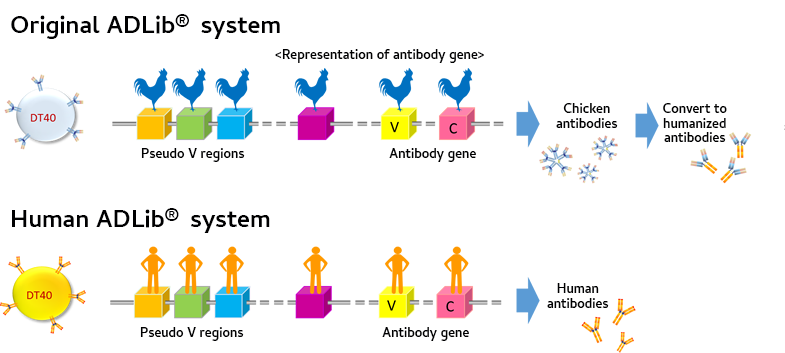
In the human ADLib® system, chicken antibody genes in DT40 cells have been replaced with human antibody genes using genetic modification technology, requiring no complex humanization processes.
Overview of human ADLib® System
Advantages over the existing antibody generation methods
The ADLib® system has the following technical advantages distinguished from existing antibody generation methods.
A possible capacity of making antibody against difficult antigen
Our immune system generates antibody against exogenous antigen, but not against the proteins comprising the body. This immunological tolerance made extremely difficult of making antibodies using the mouse hybridoma method, the most common methods for generating antibodies. In contrast, the ADLib® system utilizes in vitro antibody generation platform and therefore not limited by immunological tolerance.
Rapid antibody generation platform
A process of ADLib® system is implemented in vitro made it possible to obtain antibodies in a short period of time at around 10 days. The rapidness of making antibody in the ADLib® system is a complete contrast to conventional methods.
Creating a unique ADLib® library
One of the most important aspects of display-based antibody capture platform is the diversity of antibody molecules displayed. The ADLib® system uses the chicken immune system to ensure the diversity. In DT40 cells, various antibodies with different functions are produced by gene conversion, in which a "functional" antibody gene is partially and randomly replaced by "pseudo" antibody genes located near the functional gene. Our unique ADLib® library is created by combining the technology to activate this property of DT40 cells, which creates gene conversion based diversity, with its technology to generate naive libraries by replacing various human-derived antibody sequences with DT40 antibody genes.